 ,
a parallel is a set (Sa)
of points
,
a parallel is a set (Sa)
of points  .
.| next surface | previous surface | 2D curves | 3D curves | surfaces | fractals | polyhedra |
PARALLEL SURFACE (OR OFFSET) OF A SURFACE
| For an initial surface (S0)
with current point ,
a parallel is a set (Sa)
of points . |
Two surfaces are said to be parallel if any normal to one is normal to the other; it can be proved that, then, the distance between two points with common normal is a constant, called parallelism constant. Do not mistake this notion for the notion of translated surface.
Like for planes, the parallelism relation of surfaces is an equivalence relation.
The parallel surfaces of a surface (S0)
are the surfaces (Sa),
parallel of index a of (S0),
obtained by algebraically marking a "length" a from the points on
(S0) on the
oriented normal, in other words, it is the locus of the points M
=  where
where  is the normal vector at M0. Since
the parallelism relation is symmetric, (S0)
is also parallel to (Sa).
is the normal vector at M0. Since
the parallelism relation is symmetric, (S0)
is also parallel to (Sa).
The union of (Sa) and (S-a) is the envelope of the spheres with radius a centered on (S0).
The singular points of the parallel surfaces describe
the focal of the base surface????
A similar notion is that of level surface of the function
"distance (of a point in space) to the surface". These level surfaces are
composed of portions of parallel surfaces and portions of spheres, and
one of their interests is that they constitute a partition of space, contrary
to the parallel surfaces.
| Opposite, animation obtained by the succession of various parallel surfaces of a Moebius strip. The parallel surface of index a is identical to that of index -a, contrary to the parallel surfaces of a normal strip.... Moreover, this surface has the feature of being strictly parallel to itself. | 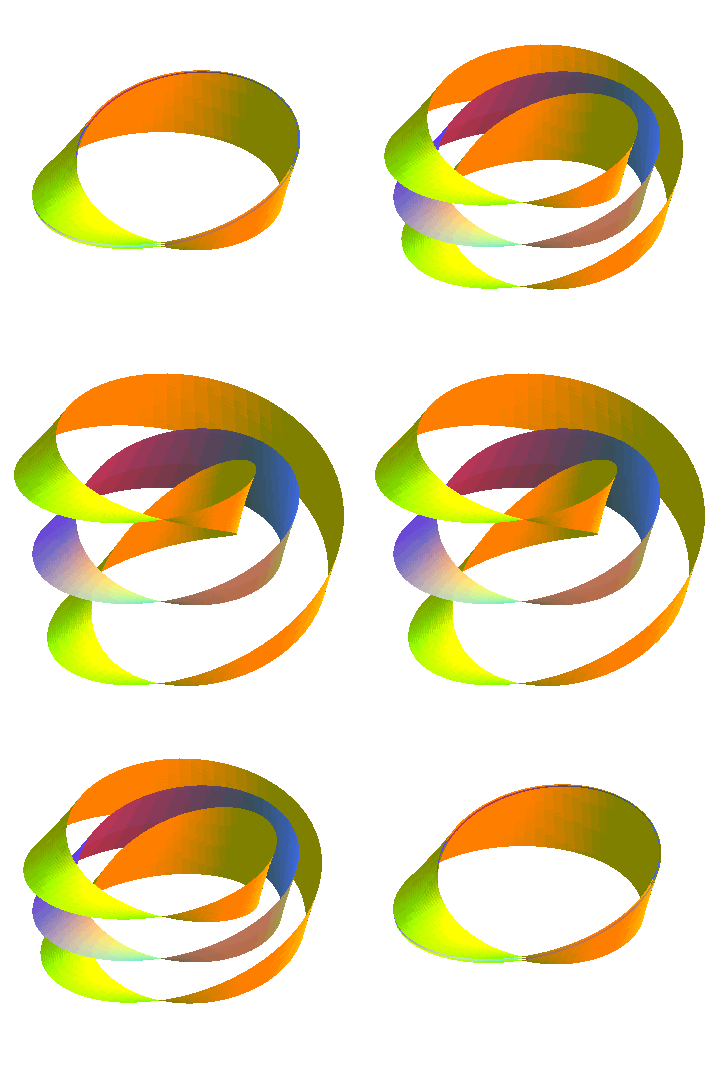 |
See also the self
parallel surfaces.
| next surface | previous surface | 2D curves | 3D curves | surfaces | fractals | polyhedra |
© Robert FERRÉOL 2017