et son transformé

loi : F–>FGF
G–>GGG
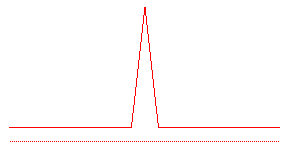
cantor(A, (2*A+B)/3, n-1),cantor((A+2*B)/3, B, n-1) fi end:
plot([cantor([0,0],[1,0],4)],axes=none,color=red);
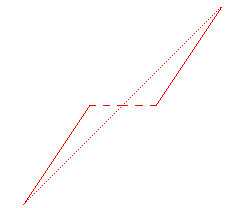
if n=0 then [a,b],[c,d] else
escalieroblique(a, b, (2*a+c)/3, (b+d)/2, n-1),
escalieroblique((a+2*c)/3, (b+d)/2, c, d, n-1)
fi end:
plot([escalieroblique(0,0,1,1,6)],axes=none,color=red);
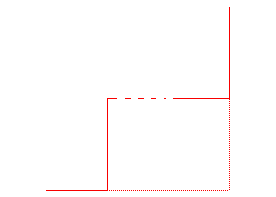
if n=0 then [a,b],[c,b],[c,d] else
escalierdroit(a, b, (2*a+c)/3, (b+d)/2, n-1),
escalierdroit((a+2*c)/3, (b+d)/2, c, d, n-1)
fi end:
plot([escalierdroit(0,0,1,1,6)],axes=none,color=red);
(t = 1/2 : escalier de Cantor,
t =2/3 : courbe de Bolzano-Lebesgue proprement dite)
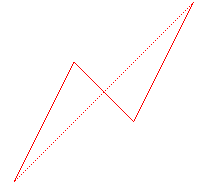
if n=0 then [a,b],[c,d] else
bolzaleb(a,b,(2*a+c)/3,(1-t)*b+t*d,t,n-1),
bolzaleb((2*a+c)/3,(1-t)*b+t*d,(a+2*c)/3,t*b+(1-t)*d,t,n-1),
bolzaleb((a+2*c)/3,t*b+(1-t)*d,c,d,t,n-1)
fi end:
plot([bolzaleb(0,0,1,1,2/3,5)],axes=none,color=red);
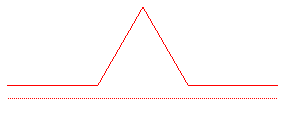
| numéro du segment | 1 | 2 | 3 | 4 |
| longueur | 1/3 | 1/3 | 1/3 | 1/3 |
| angle avec le segment de départ | 0° | 60° | -60° | 0° |
loi :
F–>F+F– –F+F
avec t = 60°
Variante :
loi :

avec t = 30°
| koch:=proc(n)
if n=0 then [1] else L:=koch(n-1): L1:= map(z->z/3,L): V:=L1[-1]:L2:=map(z->expand(V+z*exp(I*Pi/3)),L1): V:=L2[-1]:L3:=map(z->expand(V+z*exp(-I*Pi/3)),L1): V:=L3[-1]:L4:=map(z->expand(V+z),L1): [op(L1),op(L2),op(L3),op(L4)] fi: end: complexplot([0,op(koch(5))],scaling=constrained,axes=none); |
koch:=proc(A,B,n)
if n=0 then A else koch(A, (2*A+B)/3, n-1), koch((2*A+B)/3, (A+B)/2+I*(B-A)/sqrt(3)/2 ,n-1), koch((A+B)/2+I*(B-A)/sqrt(3)/2, (A+2*B)/3, n-1), koch((A+2*B)/3, B, n-1) fi end: complexplot([koch(0,1,4),1],axes=none,scaling=constrained); |
avec 1/4 £ u £ 1/2 ;
u = 1/3 : courbe de Koch,
u = 1/2 : courbe de Césaro
| numéro du segment | 1 | 2 | 3 | 4 |
| longueur | 1/2 | 1/2 | 1/2 | 1/2 |
| angle avec le segment de départ | 0° | 90° | -90° | 0° |
loi :
F–>F+F– –F+F
avec t = arccos(1/2/u-1)
| kochg:=proc(u,n)
if n=0 then [1] else L:=kochg(u,n-1):p:=nops(L):t:=arccos(1/2/u-1): L1:=map(z->z*u,L): V:=L1[p]:L2:=map(z->expand(V+z*exp(I*t)),L1): V:=L2[p]:L3:=map(z->expand(V+z*exp(-I*t)),L1): V:=L3[p]:L4:=map(z->expand(V+z),L1): [op(L1),op(L2),op(L3),op(L4)] fi: end: complexplot([0,op(kochg(0.45,5))],scaling=constrained,axes=none); |
kochg:=proc(A,B,u,n)
if n=0 then A else kochg(A, (1-u)*A+u*B, u, n-1), kochg((1-u)*A+u*B, (A+B)/2+I*(B-A)*sqrt(u-1/4), u, n-1), kochg((A+B)/2+I*(B-A)*sqrt(u-1/4), u*A+(1-u)*B, u, n-1), kochg(u*A+(1-u)*B, B, u, n-1) fi end: complexplot([kochg(0,1,0.45,4),1],axes=none,scaling=constrained); |
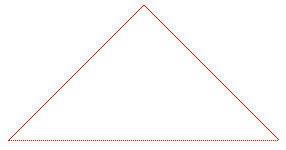
| numéro du segment | 1 | 2 |
| longueur | 1/Ö2 | 1/Ö2 |
| angle avec le segment de départ | 45° | -45° |
loi :
F–>+F– –F+
avec t = 45°
| c:=proc(n)
if n=0 then [1] else L:=c(n-1): L1:= map(z->z*(1+I)/2,L): V:=L1[-1]:L2:=map(z->expand(V+z*(1-I)/2),L): [0,op(L1),op(L2)] fi: end: complexplot(c(5),scaling=constrained,axes=none); |
c:=proc(A,B,n)
if n=0 then A else c(A, (A+B)/2+I*(B-A)/2, n-1), c((A+B)/2+I*(B-A)/2, B, n-1) fi end: complexplot([c(0,1,8),1],axes=none,color=red,scaling=constrained); |
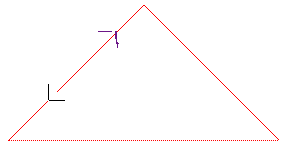
| numéro du segment | 1 | 2 |
| longueur | 1/Ö2 ; 1/Ö3 | 1/Ö2 ; 1/Ö3 |
| angle avec le segment de départ | 45° ; 30° | -45° ; -30° |
loi :

avec
t = 45° pour le dragon
t = 30° pour le terdragon
| with(plots):with(ListTools):
dragon:=proc(n) if n=0 then [0,1] else L:=dragon(n-1): L1:= map(z->z*(1+I)/2,L): V:=L1[-1]:L2:=map(z->expand(V+z*(1-I)/2),L): VV:=L2[-1]:L2:=L2[1..-2]:L2:=map(z->-z+V+VV,Reverse(L2)): [op(L1),op(L2)] fi: end: complexplot(dragon(10),scaling=constrained,axes=none); |
dragon:=proc(A,B,n)
if n=0 then [A,B] else dragon(A,(A+B)/2+I*(B-A)/2, n-1), dragon(B,(A+B)/2+I*(B-A)/2, n-1) fi end: plot(map(X ->map(z ->[Re(z),Im(z)],X),[dragon(0,1,8)]),axes=none,scaling=constrained); |
(deuxième type)
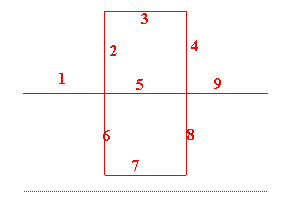
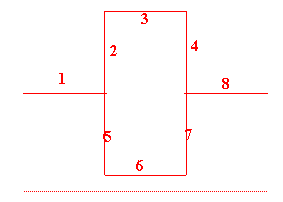
| numéro du segment | 1 | 2 | 3 | 4 | 5 | 6 | 7 | 8 | 9 |
| longueur | 1/3 | 1/3 | 1/3 | 1/3 | 1/3 | 1/3 | 1/3 | 1/3 | 1/3 |
| angle avec le segment de départ | 0° | 90° | 0° | -90° | 180° | -90° | 0° | 90° | 0° |
loi :
F–>F+F–F–F–F
+F+F+F–F
avec t = 90°
peano(A,(2*A+B)/3,n-1),
peano((2*A+B)/3,(2*A+B)/3+I*(B-A)/3,n-1),
peano((2*A+B)/3+I*(B-A)/3,(A+2*B)/3+I*(B-A)/3,n-1),
peano((A+2*B)/3+I*(B-A)/3,(A+2*B)/3,n-1),
peano((A+2*B)/3,(2*A+B)/3,n-1),
peano((2*A+B)/3,(2*A+B)/3-I*(B-A)/3,n-1),
peano((2*A+B)/3-I*(B-A)/3,(A+2*B)/3-I*(B-A)/3,n-1),
peano((A+2*B)/3-I*(B-A)/3,(A+2*B)/3,n-1),
peano((A+2*B)/3,B,n-1)
fi end:
complexplot([peano(0,1+I,3),1+I]),axes=none,color=red,scaling=constrained);
(premier type)

loi :
F–>F+F–F–G–F
+F+F+F–F
avec t = 90°
peanosierp(A,(2*A+B)/3,n-1),
peanosierp((2*A+B)/3,(2*A+B)/3+I*(B-A)/3,n-1),
peanosierp((2*A+B)/3+I*(B-A)/3,(A+2*B)/3+I*(B-A)/3,n-1),
peanosierp((A+2*B)/3+I*(B-A)/3,(A+2*B)/3,n-1),
peanosierp((2*A+B)/3,(2*A+B)/3-I*(B-A)/3,n-1),
peanosierp((2*A+B)/3-I*(B-A)/3,(A+2*B)/3-I*(B-A)/3,n-1),
peanosierp((A+2*B)/3-I*(B-A)/3,(A+2*B)/3,n-1),
peanosierp((A+2*B)/3,B,n-1)
fi end:
plot(map(X ->map(z ->[Re(z),Im(z)],X),[peanosierp(0,1+I,3)]),axes=none,scaling=constrained);
comprenant
le terdragon
et le contour de l'île de Gosper

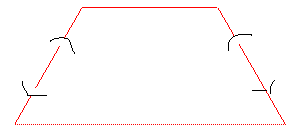
if n=0 or abs(B-A)<0.01 then A else P,Q:=(1-t)*A+t*B+I*(B-A)*v,(1-u)*B+u*A+I*(B-A)*w:
troisbarres(A,P,n-1,t,v,u,w),
troisbarres(P,Q,n-1,t,v,u,w),
troisbarres(Q,B,n-1,t,v,u,w)
fi end:
dess:=troisbarres(0,1,30,0.1,0.2,0.1,-0.2):
complexplot([dess,1],scaling=constrained,axes=none);
| numéro du segment | 1 | 2 | 3 |
| longueur | 1/2 | 1/2 | 1/2 |
| angle avec le segment de départ | 60° | 0° | 60° |
| with(plots): t:=Pi/3:r:=1+2*cos(t):
sierpinski:=proc(n) if n=0 then [1] else L:=sierpinski(n-1): L1:=map(z->conjugate(z)*exp(t*I)/r,L): L2:=map(z->L1[-1]+z/r,L): L3:=map(z->conjugate(z)*exp(-t*I)/r+L2[-1],L): [op(L1),op(L2),op(L3)]: fi end: complexplot([0,op(sierpinski(5))],scaling=constrained,axes=none); |
t:=Pi/3:r:=1+2*cos(t):
sierpinski:= proc(A,B,n) if n=0 then [A,B]: else P,Q:=A+(B-A)*exp(I*t)/r,B-(B-A)*exp(-I*t)/r: sierpinski(P,A,n-1), sierpinski(P,Q,n-1), sierpinski(B,Q,n-1) fi: end: plot(map(X ->map(z ->[Re(z),Im(z)],X),[sierpinski(0,1,5)]), axes=none,color=red,scaling=constrained); |
(premier type)
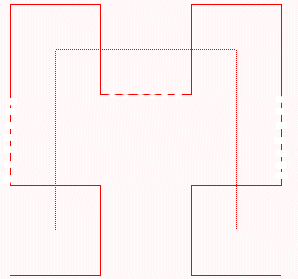
Y –> –XF+YFY+FX–
if n=0 then (3*A+B)/4+e*I*(B-A)/4,(3*A+B)/4+3*e*I*(B-A)/4,
(A+3*B)/4+3*I*e*(B-A)/4,(A+3*B)/4+e*I*(B-A)/4 else
hilbert(A,A+e*I*(B-A)/2,n-1,-e),
hilbert(A+e*I*(B-A)/2,(A+B)/2+e*I*(B-A)/2,n-1,e),
hilbert((A+B)/2+e*I*(B-A)/2,B+e*I*(B-A)/2,n-1,e),
hilbert(B+e*I*(B-A)/2,B,n-1,-e)
fi end:
complexplot([hilbert(0,1,2,1)]),axes=none,color=red,scaling=constrained);
(deuxième type)

if n=0 then [A,B] else
hilbert2(A+I*(B-A)/2,A,n-1),
hilbert2(A+I*(B-A)/2,(A+B)/2+I*(B-A)/2,n-1),
hilbert2((A+B)/2+I*(B-A)/2,B+I*(B-A)/2,n-1),
hilbert2(B,B+I*(B-A)/2,n-1)
fi end:
complexplot([hilbert2(0,1,4)]),axes=none,color=red,scaling=constrained);
départ : A
loi :
A –> B–A–B,
B –> A+B+A
angle : 60º
if n=0 then [A,B] else
sierpinski((3*A+B)/4+I*(B-A)*sqrt(3)/4,A,n-1),
sierpinski((3*A+B)/4+I*(B-A)*sqrt(3)/4,(A+3*B)/4+I*(B-A)*sqrt(3)/4,n-1),
sierpinski(B,(A+3*B)/4+I*(B-A)*sqrt(3)/4,n-1)
fi end:
plot(map(X ->map(z ->[Re(z),Im(z)],X),[sierpinski(0,1,6)]),axes=none,color=red,scaling=constrained);
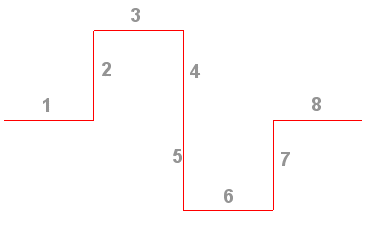
| numéro du segment | 1 | 2 | 3 | 4 | 5 | 6 | 7 | 8 |
| longueur | 1/3 | 1/3 | 1/3 | 1/3 | 1/3 | 1/3 | 1/3 | 1/3 |
| angle avec le segment de départ | 0° | 90° | 0° | -90° | -90° | 0° | 90° | 0° |
loi :
F–>F–F+F+FF–F–F+F
| with(plots):with(ListTools):
mink:=proc(m) if m=0 then [0,1]: else L1:=mink(m-1): r:= m mod 3: if r=1 then rot:=-I elif r=2 then rot:=+I else rot:=-1 fi: V:=L1[-1]:L11:=L1[1..-2]:L2:=Reverse(map(z->V+(z-V)*rot,L11)): res:=[op(L1),op(L2)]:if r=0 then res:=map(z->z/4,res) fi : res fi: end: n:=3:complexplot(mink(3*n),axes=none,scaling=constrained); |
mink:=proc(A,B,n)
if n=0 then A else mink(A,(3*A+B)/4,n-1), mink((3*A+B)/4,(3*A+B)/4+I*(B-A)/4,n-1), mink((3*A+B)/4+I*(B-A)/4,(A+B)/2+I*(B-A)/4,n-1), mink((A+B)/2+I*(B-A)/4,(A+B)/2,n-1), mink((A+B)/2,(A+B)/2-I*(B-A)/4,n-1), mink((B+A)/2-I*(B-A)/4,(A+3*B)/4-I*(B-A)/4,n-1), mink((3*B+A)/4-I*(B-A)/4,(A+3*B)/4,n-1), mink((A+3*B)/4,B,n-1) fi end: complexplot([mink(0,1,1),1],axes=none,color=red,scaling=constrained); |
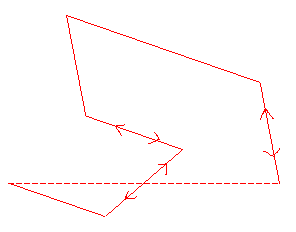
| numéro du segment | 1 | 2 | 3 | 4 | 5 | 6 | 7 |
| longueur | 1/Ö7 | 1/Ö7 | 1/Ö7 | 1/Ö7 | 1/Ö7 | 1/Ö7 | 1/Ö7 |
| angle avec le segment de départ | 0-a° | 60-a° | 180-a° | 120-a° | -a° | -a° | -60-a° |
u:=evalf(exp(I*Pi/3)):v:=evalf((B-A)*exp(-I*arctan(sqrt(3)/5))/sqrt(7)):
P:=A+v:Q:=P+u*v:R:=Q-v:S:=R+u^2*v:T:=S+v:U:=T+v:
if n=0 then[A,B] else
gosper(A,P,n-1),
gosper(Q,P,n-1),
gosper(R,Q,n-1),
gosper(R,S,n-1),
gosper(S,T,n-1),
gosper(T,U,n-1),
gosper(B,U,n-1)
fi end:
complexplot([gosper(0,1,4)],axes=none,color=red,scaling=constrained);

if n=0 then [A,B] else u:=exp(I*Pi/3)/3:
C,D,E,F,G,H:=A+u*(B-A),A+2*u*(B-A),A+(2*u+1/3)*(B-A),A+(2/3+u)*(B-A),A+(B-A)/3,A+2*(B-A)/3:
kochp(C,A, n-1), kochp(C,D, n-1), kochp(D,E, n-1),kochp(E,F, n-1),kochp(G,F, n-1), kochp(H,G, n-1), kochp(H,B, n-1) fi end:
n:=3:plot(map(X ->map(z ->[Re(z),Im(z)],X),[kochp(0,1,n,1)]),axes=none,color=blue,scaling=constrained,thickness=2);
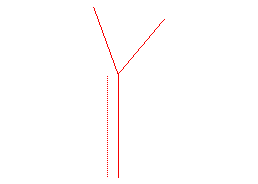
local k,M;
k:=nops(L):M:=evalf([seq(L[q]*exp(t[q]*I),q=1..k)]);
if n=0 then [A,B] else
[A,B],seq(arbre(B,B+M[q]*(B-A),L,t,n-1),q=1..k)
fi end:
complexplot([arbre(0,I,[0.7,0.7],[Pi/9,-2*Pi/9],7)],
axes=none,color=COLOR(RGB,0.55,0.2,0),scaling=constrained);
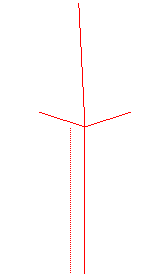
local k,M;
k:=nops(L):M:=evalf([seq(L[q]*exp(t[q]*I),q=1..k)]);
if n=0 then [A,B] else [A,B],
fougere(B,B+M[1]*(B-A),L,t,n-1),
fougere(B,B+M[2]*(B-A),L,subsop(1=-t[1],t),n-1),
fougere(B,B+M[3]*(B-A),L,t,n-1)
fi end:
complexplot([fougere(0,I,[0.85,0.33,0.33],[0.05,0.4*Pi,-0.4*Pi],5)]),
axes=none,color=COLOR(RGB,0.1,0.9,0),scaling=constrained);